Shanghai AI Comprehensive Assessment System
Digital Safety Training · Assessment and Records
Core highlights
Using the 'one-code connected identity' as a link, it connects facial verification, immersive practical training, consortium blockchain evidence preservation, and mobile collaboration, upgrading work safety training from 'digital records' to a 'trusted on-chain closed loop'.
Swiping an ID card to check in immediately generates a unique identity QR code. The code is claimed on a mobile phone, scanned by devices, linked to scores, and check-out is recorded on-chain. A single code runs throughout the entire process, making responsibilities traceable.
The transcript's SHA-256 fingerprint is anchored to the FISCO BCOS consortium blockchain, providing tamper resistance, traceability, and verifiability, giving training records 'on-chain credibility'.
Digital twin teaching command center aggregates KPIs, device topology, blockchain dashboards, and leaderboards in real time, providing a full view of training on one screen.
ID card reading + camera facial recognition dual comparison prevents impersonation; check-in immediately completes identity authenticity verification.
Physical hardware such as fire extinguishers, safety helmets, safety shoes, virtual welding, and confined spaces are linked via serial ports, enabling real-person hands-on operation and an immersive experience.
Trainees scan a QR code on their mobile phones to enter H5, where they can claim codes, answer questions, check scores, and view learning materials; assessment results can be verified on-chain with one click.
Screenshots and on-site photos
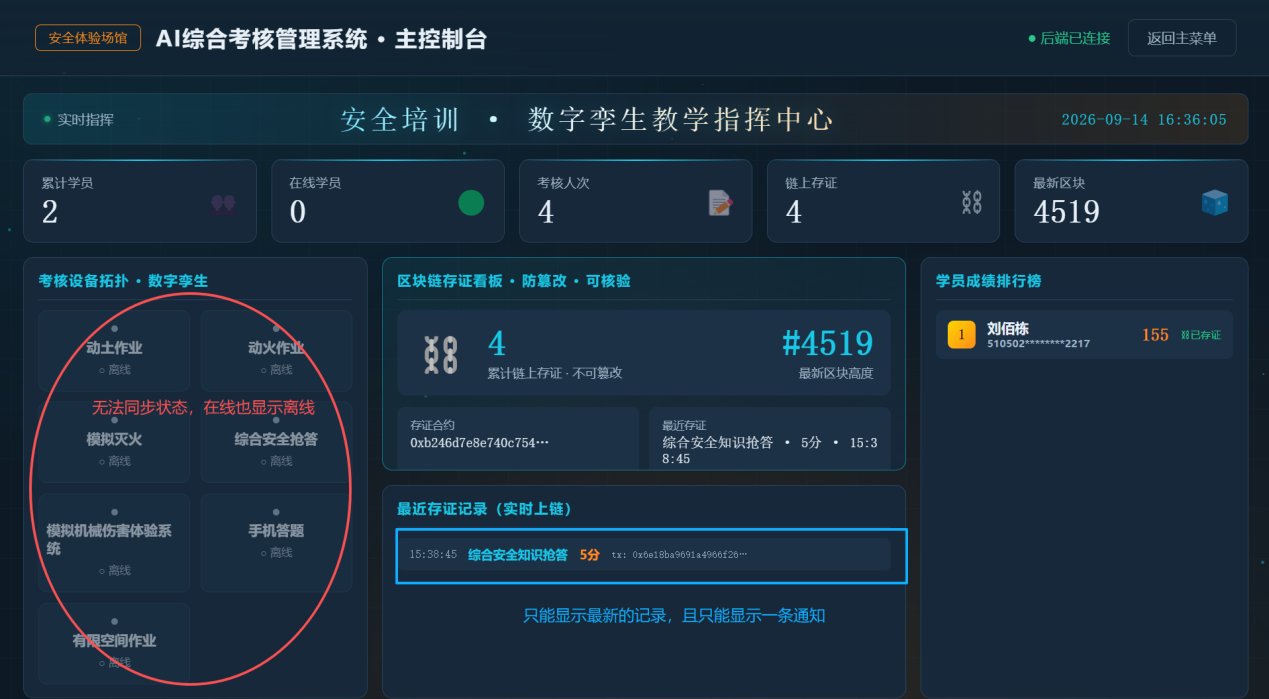
KPI · Device Topology · Blockchain Attestation Dashboard · Leaderboard

Card reading auto-fills the number · Camera-based face-to-ID verification
Hot Work Virtual Welding / Confined Space Operations
Technology stack in use
Nine software modules work in concert to cover the complete closed loop of “Check-in → Seven Assessment Types → Attestation.” All system scores are uniformly reported, uniformly linked to identities, and uniformly anchored to the blockchain.
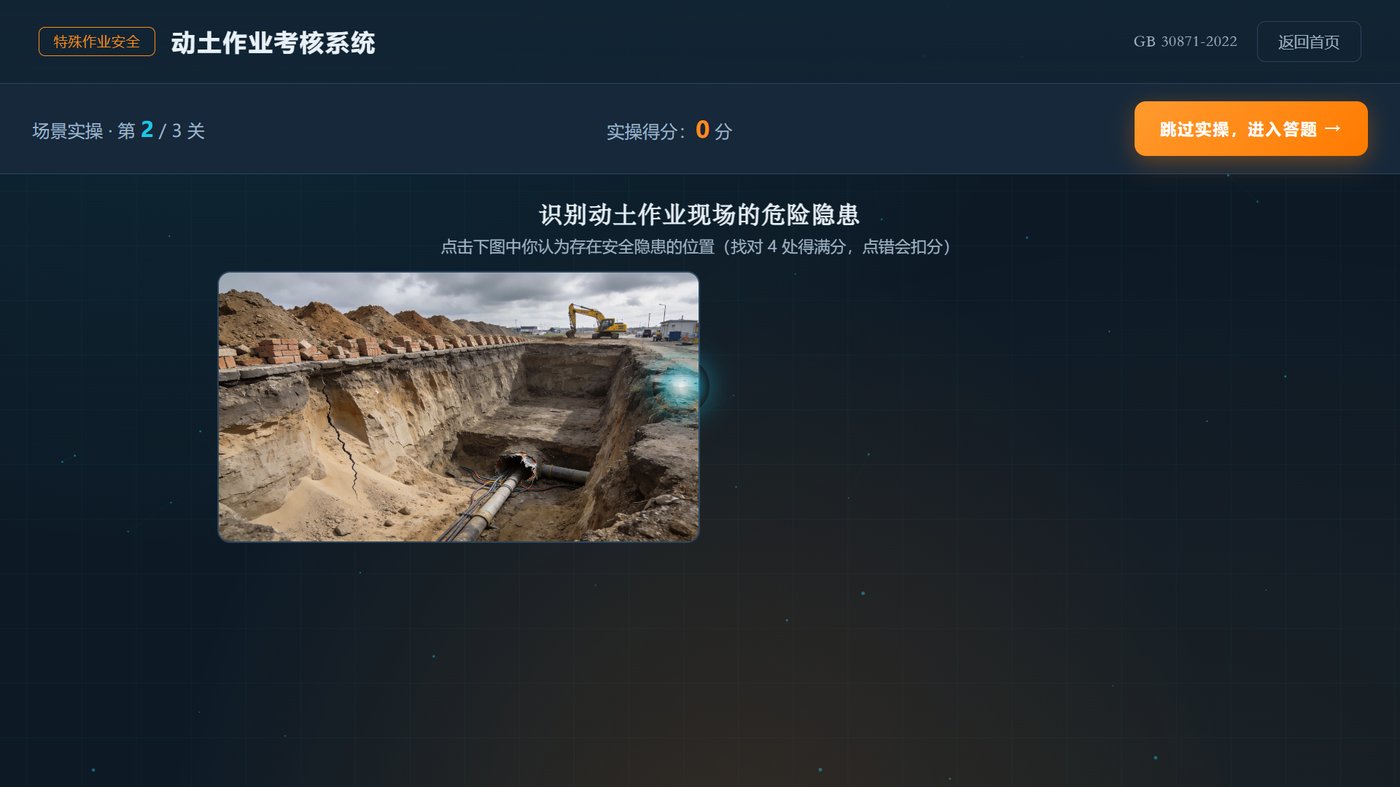
Excavation work safety knowledge learning and question-answering assessment, ground projection radar stepping interaction (TUIO protocol), camera QR code scanning for identity recognition, automatic reporting.
Hot Work Safety Training: realistic virtual welding operation + knowledge learning + video cases + quiz, with QR code identity verification and automatic reporting.
Three-themed safety knowledge quick-response quiz covering traffic, production, and fire safety. Three quiz teams scan a QR code to take their seats; results are automatically reported when the quiz ends.
Physical fire extinguisher model with serial port linkage; swipe an ID card for hands-on fire extinguishing; the assessment includes gas/liquid fire classification questions and automatically reports.
Safety helmet + safety shoes serial-port-triggered practical operation; simulates rolling mill mechanical injury scenario; automatic score reporting after quiz.
Fan / smoke machine / gas detector linkage, 14 operation steps + 10 rescue steps + knowledge assessment, ID card swipe + device heartbeat online.
Trainees scan QR code on mobile to enter; log in to generate a QR code, answer questions, check scores, study via text, images, and videos, and verify score reports on blockchain.
Card check-in + identity verification + digital twin large screen (KPI / device topology / blockchain dashboard / leaderboard) + checkout attestation.
Unified aggregation of scores from seven sets of devices, mobile hosting, blockchain attestation bridging, large-screen data aggregation, port 8090.
Blockchain · consortium-chain attestation
Adopts the domestically developed open-source consortium blockchain FISCO BCOS (PBFT consensus) to anchor the fingerprint of every score report on-chain, upgrading safety training records from 'enterprise self-attestation' to 'on-chain public credibility.'
Pain points of traditional assessment
- Results are stored in a local database / file, can be directly modified from the backend, and are difficult to verify as authentic.
- Paper ledgers are easily lost and forged, making regulatory and audit evidence collection difficult
- Training records cannot self-prove “when, by whom, and with what score,” lacking credibility
- Data silos prevent mutual trust and recognition across different systems and institutions
Value of the consortium chain
- Tamper-proof: Transcript SHA-256 fingerprints are anchored on-chain; any alteration can be detected immediately
- Traceable: Each score is bound to a transaction hash + block height, leaving a full trace and permanently queryable
- Verifiable: Scan the transcript QR code to verify on-chain, without any central authority endorsement
- Privacy compliance: Only stores desensitised hashes of ID cards, with no plaintext retained, meeting personal information protection requirements
See the full attestation mechanism →
From assessment to attestation
Verification loop · tamper-proof
Generate a score report + on-chain credential.→Scan the QR code.
Mobile phone / verification page reads the hash.→On-chain query
verifyEvidence Contract Call→✓ Verification Passed
verified:true · Display On-chain Records
✗ Data Tampered Hash Does Not Match → verified:false
Identity + face verification
During check-in, dual verification of 'real name + real person' is completed: the ID card reader reads the chip identity information, the camera captures the face in real time, and only when the two match is entry allowed, eliminating impersonation at the source.
- ID card readingThe Jinglun CVR-100A/U card reader with Termb.dll driver automatically reads the ID number, name, gender and chip photo, with no manual entry required at any point.
- Facial recognition: face-api.js local offline model (tiny_face_detector + face_landmark_68 + face_recognition), no internet connection required, no privacy leaks.
- 1:1 comparison128-dimensional feature vectors are extracted from the ID chip photo and the camera-captured face; a Euclidean distance below 0.6 is judged to be the same person.
- Result traceabilityThe ID photo and the on-site captured photo are both stored in the check-in record and displayed side by side on the score report, providing solid evidence for audits.
Card reading auto-fills the number · Camera-based face-to-ID verification
Hands-on interaction · real equipment
Assessment is not 'answering questions on a screen,' but 'hands-on operation of real hardware.' Unity 3D scenes are linked to physical devices via serial ports, enabling trainees to complete practical assessments in a realistic work environment.
Physical fire extinguisher model with serial port linkage; the handle, safety pin, and spray direction are realistically controlled; identify the fire category and select the corresponding extinguishing method.
Unity · Serial port linkageWearable sensors in safety helmets and safety shoes are triggered via serial port, simulating rolling mill mechanical injury risk scenarios and letting trainees experience the consequences of violations.
Unity · Serial port linkageRealistic virtual welding operation, simulating the hot work environment and operating standards, integrating knowledge learning + video cases + quizzes.
Unity 2019 · Virtual weldingFans, smoke generators, and gas detectors are coordinated for a full-process drill of 14 operation steps + 10 rescue steps, recreating real operational risks.
Unity · Multi-Device CoordinationScenario practice · find hazards in real photos
Excavation Work · Scenario-Based Hands-On Practice Identify On-Site Hazards · Ground-Projection Radar Interaction.
Real-Scene RecognitionReal construction-site photos are used for the "Spot the Hazard" exercise: correct finds earn points, wrong clicks deduct points, assessing hazard identification ability.
Ground Projection Radar: The excavation equipment uses ground projection + radar footstep interaction (TUIO / UDP protocol); trainees can click wherever they walk.
Sorting practical operation.: Work step sequencing questions; if a wrong choice is selected, the correct order is displayed immediately, enabling learning while practicing.
Item-by-item scoringEach level is scored independently (sequencing 20 + hazard spotting 20 + scenario judgment 10); upon completion, results are automatically reported to the backend.
Mobile · phone collaboration
Trainees need no app. They can scan a QR code on their phone to enter the H5 mobile page and complete code claiming, question answering, score checking, learning material access, and score verification, seamlessly coordinating with on-site devices.
- Scan to Log In and Claim CodeLog in by entering the ID number to generate "My QR Code", which serves as the sole identity credential across the entire venue.
- Mobile QuizQuestions are drawn randomly from the question bank with options shuffled; once answering ends, the score is synchronized to the backend and linked to the respondent's identity.
- Scores and Verification: View scores for all subjects; scan the transcript QR code to verify authenticity on the blockchain, and it will never be lost.
- Text, Image & Video Learning: Built-in illustrated knowledge points + video cases; external configuration can be updated on-site; learn while testing.
- Externally adjustable configurationQuestions, learning materials and videos are all configured via external JSON, so content can be changed on site without re-releasing the program.
Application value
This system is not only a safety assessment tool, but also a pioneering model for safety education's transition from 'digitalization' to 'trustworthiness' using a domestically developed, independently controllable consortium blockchain to upgrade safety training records from 'enterprise self-attestation' to 'on-chain public credibility.'
Value to the client
Score reports are recorded on-chain, preventing fraud and providing a reliable basis for supervision and auditing.
Check-in, assessment, scores, and evidence preservation on one chain, making accountability traceable.
Existing safety Experience Center hardware remains unchanged, with Party building and other services layered on.
FISCO BCOS open-source consortium blockchain, financial-grade reliability, no external dependencies.
How safety education evolves
Manual records: easily lost, easily falsified, difficult to audit→Digital assessment
Automatically recorded by the system, but data can still be modified in the backend→Blockchain-based on-chain attestation
Scores anchored on-chain: tamper-proof and permanently verifiable
Future extensibility: training certificate issuance, special operation certificates, training hour attestation, and mutual recognition among multiple institutions.
FISCO BCOS Consortium Blockchain | Person-ID verification · Immersive interaction · Mobile collaboration
Prices are not displayed on this page; a formal quotation will be provided after an on-site survey.